
From Loyalist to Nemesis: The Making of Péter Magyar
From Loyalist to Nemesis: The Making of Péter Magyar
 Tosin Adeoti
 Péter Magyar — The Man Who Toppled Orbán
On April 7 in Budapest, a small crowd gathered beneath the stone arches of the Hungarian Parliament building, the Danube, Europe’s second-longest river, moving slowly behind them. Cameras waited patiently while reporters shuffled their notes. A stage had been built facing the river, and the red-white-and-green Hungarian flag fluttered in the breeze. Foreign politicians had already arrived in the country days earlier, lending their presence to the most consequential election Hungary had faced in a generation. Among them was the American Vice President JD Vance, who had traveled, at the behest of President Donald Trump, to campaign alongside Hungary’s long-serving prime minister, Viktor Orbán. Trump is particularly enamoured of Orban, praising him all year. In one instance, he had said, “I love that Viktor, I’ll tell you, he’s a fantastic man, we’ve had a tremendous relationship”.
With the dispatch of his deputy to Hungary, the symbolism was unmistakable. Orbán had ruled Hungary for sixteen years and had become one of the most influential figures in global right-wing politics. Even as admirers in Washington praised him as a defender of national sovereignty, the Kremlin preferred him as a partner who resisted European pressure. Across much of the European Union, however, leaders regarded him as a problem. Brussels had frozen billions of euros in development funds amid accusations that Hungary’s democratic institutions had been hollowed out. The election unfolding that week felt less like a domestic contest and more like a referendum on an entire political model.
Few people watching the rally that afternoon outside Hungary imagined that the man who would defeat Orbán had once admired him so deeply that his photograph hung on a bedroom wall.
The boy who placed that poster there was named Péter Magyar. In the early 1990s, Hungary was emerging from the long shadow of communist rule. With the collapse of the Soviet Union, Russian troops were leaving Central Europe. On television screens across the country, a young politician named Viktor Orbán delivered fiery speeches demanding independence and democratic reforms. For teenagers growing up during that turbulent moment, Orbán seemed fearless. Magyar, like many others, watched those speeches and felt something close to awe.
Magyar grew up in a well-known Budapest family that moved comfortably inside Hungary’s legal and political circles. His relatives included judges and prominent lawyers. One of them, Ferenc Mádl, would later serve as Hungary’s president from 2000 to 2005. So, Magyar did not stumble on policies, it was already in conversations around the dinner table as he grew up. Magyar studied law in Budapest and developed the habit that friends would later describe as an obsession with public affairs. He debated policy questions late into the night and followed election campaigns the way some people follow football leagues.
In 2003, the man born in 1981 joined Orbán’s political party, Fidesz. The movement had transformed itself from a liberal youth organization into a nationalist conservative force determined to dominate Hungarian politics. Magyar’s early career unfolded inside that machine. He worked as a lawyer, moved into government roles, and spent time in Brussels as a diplomat representing Hungarian interests inside the European Union. During those years he married Judit Varga, a rising star within the same party. Their lives followed the path of a successful political family. They lived abroad for several years while she worked for a member of the European Parliament. Eventually, they returned to Budapest with their three sons.
When Orbán returned to power in 2010, he did so with extraordinary force. His government rewrote parts of the constitution and built a political network that critics described as a system designed to last indefinitely. Varga’s career flourished inside that world. In 2019 Orbán appointed her justice minister. Magyar, still loyal to the party, continued his work in state institutions. From the outside the arrangement appeared stable, even comfortable.
The rupture began in early 2024 with a scandal that struck at the moral language Orbán had used for years to define his government. Hungary’s president at the time, Katalin Novák, had issued a pardon to a man convicted of helping conceal sexual abuse at a children’s home. The revelation ignited public anger. Demonstrators filled Budapest streets demanding explanations. The government’s carefully cultivated image as a protector of traditional family values suddenly looked fragile.
Varga signed documents related to the pardon. As the political storm intensified she resigned. Novák stepped down as president. In the middle of that crisis, Magyar did something that stunned Hungarian politics. He turned against the party he had served for two decades.
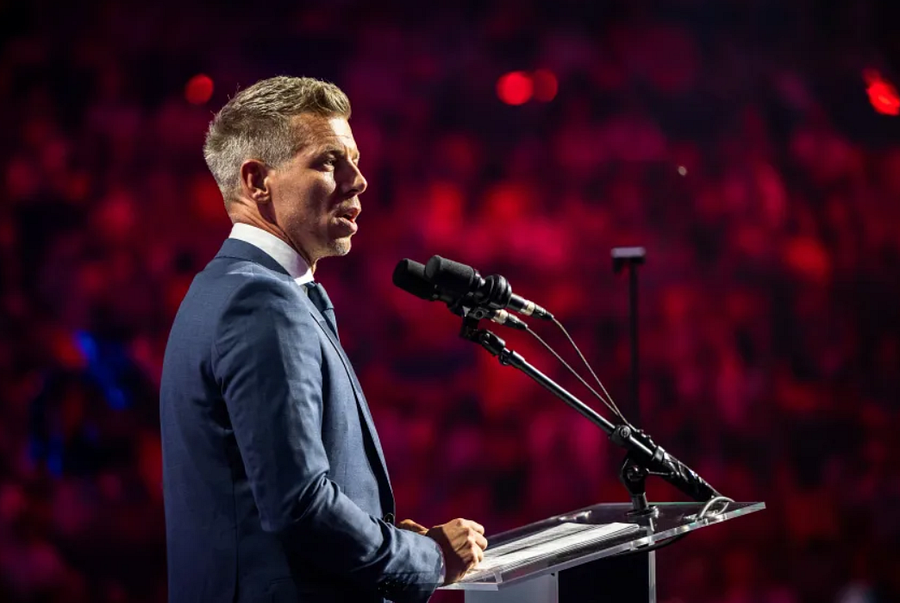
In February 2024 he appeared in a video interview with the independent media outlet Partizán. The conversation lasted nearly an hour. Magyar spoke calmly at first, describing how power operated inside Orbán’s system. Then his tone sharpened. He accused the leadership of hiding behind women’s reputations during the scandal. He suggested that a small circle of families controlled vast portions of Hungary’s economy. The interview spread across social media with such astonishing speed that even Magyar had not expected. In a country of fewer than ten million people it gathered millions of views.
Within weeks Magyar joined a small opposition movement known as the Tisza Party. The name carried a double meaning. Tisza is the name of one of Hungary’s great rivers. It is also an acronym derived from Hungarian words meaning respect and freedom. The party had been obscure before his arrival. Suddenly it filled meeting halls.
Magyar traveled across the country in an aging Ford Transit van, stopping in villages and towns where opposition politicians rarely appeared. He spoke in school auditoriums and public squares. After each speech he remained for hours shaking hands and listening to complaints about inflation and the sense that Hungary’s wealth had been captured by a narrow elite. In one eastern village near the Romanian border, a retired postal worker named Éva Szabó waited patiently in line to meet him. She told reporters she had supported other opposition candidates in the past but none had convinced her they could win. This time felt different. “It’s either him or dictatorship,” she said.
Orbán’s campaign attacked Magyar relentlessly. Government billboards placed his face beside those of foreign leaders accused of threatening Hungary’s sovereignty. State-aligned media circulated rumors about his private life. Magyar responded with a mixture of defiance and humor that frustrated his opponents. When critics mocked his clothing style in a video, he posted photographs online holding bananas and making milkshakes, turning the ridicule into a viral joke.
Meanwhile his movement grew with startling speed. In the June 2024 election for the European Parliament, the Tisza Party captured nearly thirty percent of Hungary’s vote. The result sent Magyar to Brussels as a member of the parliament and signaled that Orbán finally faced a challenger capable of reaching conservative voters who had once supported him.
Magyar’s strategy during the national campaign puzzled many observers. He refused to engage in Hungary’s bitter cultural battles. Questions about LGBTQ rights or ideological disputes were careful avoided and attention were shifted back to economic problems. He spoke constantly about corruption and stagnant wages. He also spoke about the billions of euros in European Union funds that Brussels had frozen because of concerns about Hungary’s rule of law. That money amounted to roughly ten percent of the country’s annual economic output. Recovering it, he argued, required rebuilding trust with Europe.
On election night on April 12, the atmosphere in Budapest felt tense and electric. Thousands gathered along the Danube waiting for results. When the final numbers appeared, it was a political earthquake. The Tisza Party had won a commanding majority in parliament with turnout of 77%, higher than any election since the end of communist rule. Orbán, the dominant figure of Hungarian politics for more than a decade and a half, had been defeated.
Magyar walked through the crowd carrying the Hungarian flag while Frank Sinatra’s voice echoed from loudspeakers singing “My Way.” Supporters waved banners and chanted his name. Some of them admitted they still had doubts about him. Others remembered that he once stood inside the very system he had overthrown. Nonetheless they had concluded that change required a figure who understood that system from within.
In his first remarks as Hungary’s new leader, Magyar promised that dismantling Orbán’s political architecture would take time. He spoke about restoring checks and balances and persuading European partners to release billions in frozen funds. The task ahead looked enormous. The structures built during sixteen years of Orbán’s rule would not disappear overnight.
Still, that evening carried its own unmistakable meaning. A boy who had once admired Viktor Orbán enough to hang his portrait on a bedroom wall had grown into the politician who finally ended his era. The river flowed quietly beside the parliament building as the celebration continued deep into the night, and Hungary stepped into an uncertain but unmistakably new chapter.

