
Inside the Deadliest Year for the Press
Inside the Deadliest Year for the Press
 Tosin Adeoti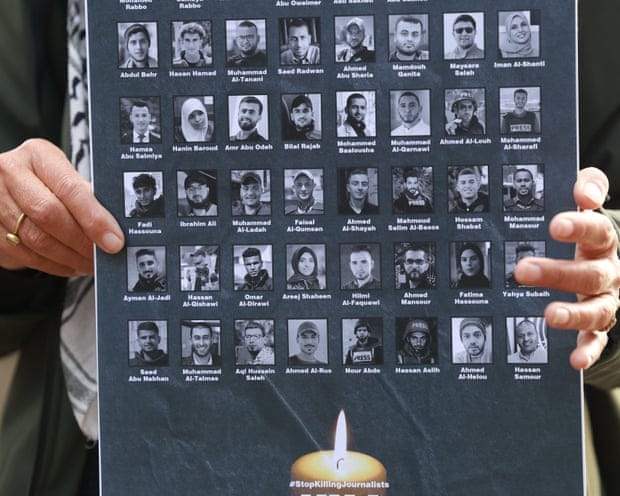
The most dangerous place in the world today may not be the front line. Increasingly, it is behind a camera lens or a reporter’s notebook. In 2025, the world lost 129 journalists and media workers to violence connected to their profession. According to the Committee to Protect Journalists, this represents the highest annual toll ever recorded, surpassing the previous grim milestone set only a year earlier. The trajectory is deeply disquieting.
The statistics become even more stark upon closer scrutiny. Of the 129 journalists killed, 86 deaths were attributed to Israeli forces, amounting to roughly two-thirds of the global total. More striking still, Israel was reportedly responsible for 81 percent of the 47 killings that the CPJ classified as intentional. These figures, while clinical on paper, represent the abrupt extinguishing of human voices whose only apparent offense was bearing witness.
Since October 2023, Israel has largely barred foreign journalists from entering Gaza, creating an informational bottleneck with profound implications. In the absence of international media presence, local Palestinian reporters have become the primary chroniclers of events on the ground. This reality has elevated both their importance and their vulnerability. The CPJ has observed that the Israeli military has now carried out more targeted killings of journalists than any other government military on record since the organization began its data collection more than three decades ago.
Israeli authorities have consistently maintained that their forces target combatants rather than members of the press, emphasizing the inherent hazards of operating within active conflict zones. However, in several contentious cases, journalists were killed after Israel alleged links to Hamas without publicly furnishing verifiable evidence. The CPJ has described such allegations as “deadly smears,” a phrase that captures the gravity of imputing militancy to individuals whose professional mandate is documentation, not participation.
Behind the aggregate numbers lie deeply human tragedies. Among those killed was Reuters cameraman Hussam al-Masri, who died while operating a live video feed at Nasser hospital. Another was Anas al-Sharif of Al Jazeera, one of the most recognizable journalistic voices reporting from Gaza. Before his death, he left a poignant final message entrusting his family to the public. The statement has since become emblematic of the perilous intersection between journalism and modern warfare.
Although Gaza dominates the present discourse, the broader pattern is unmistakably global. At least 104 of the 129 journalists killed in 2025 died in conflict environments. Sudan recorded nine journalist deaths. Mexico saw six. Three journalists were killed in the Philippines, while four Ukrainian journalists lost their lives during the ongoing war involving Russian forces. The geography varies, but the underlying precarity of the profession remains disturbingly consistent.
War reporting has never been a vocation for the faint-hearted. Yet what distinguishes the current moment is the accelerating scale and frequency of journalist fatalities. The profession is becoming more perilous at a pace that appears to outstrip the evolution of protective norms and enforcement mechanisms. This asymmetry should alarm policymakers, media institutions, and civil society alike.
Journalists perform a function that is both prosaic and indispensable: they bear witness. When they are killed, intimidated, or systematically excluded, the immediate loss is human, but the secondary loss is epistemic. The global public’s ability to apprehend reality becomes attenuated. When foreign reporters cannot enter Gaza and local journalists are dying in significant numbers, the informational ecosystem contracts. What remains is often fragmentary, contested, and susceptible to manipulation.
This moment therefore demands more than transient outrage. It calls for sober reflection and, ideally, concerted action. Are existing international protections for journalists in conflict zones still fit for purpose? Are states being subjected to consistent standards of accountability? And perhaps most unsettling of all, who documents the truth when the documentarians themselves become targets?
The deaths of 129 journalists in a single year should not be absorbed into the background noise of global crises. They constitute a warning signal of considerable magnitude. If the present trajectory persists, future conflicts may unfold with fewer witnesses and a progressively obscured historical record. By the time the full implications become evident, the informational void may already be irreparable.

