
Book Review — “The Story of Philosophy” by Will Durant
Book Review — “The Story of Philosophy” by Will Durant
 Tosin Adeoti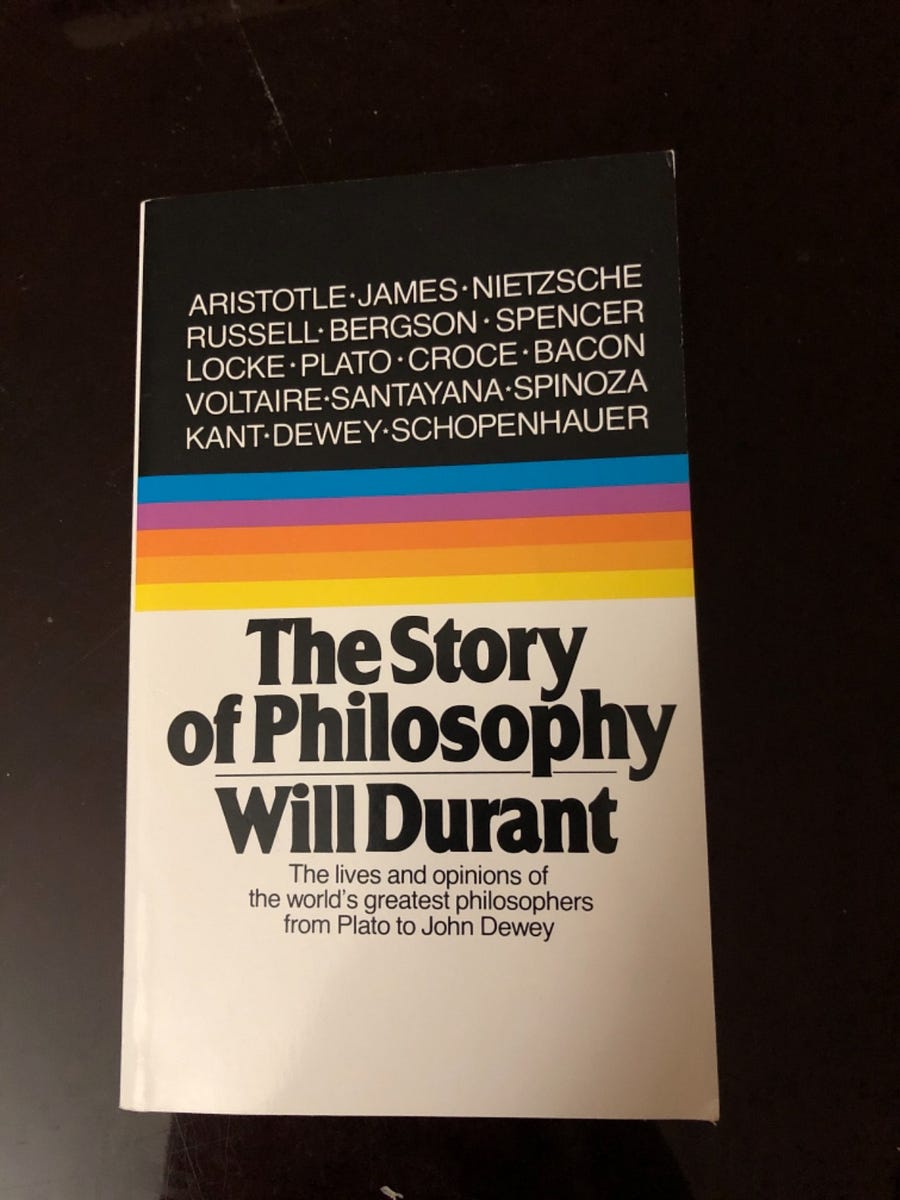
This is the book that took me longest to read in 2025. I read parts of it, left it, picked up another book, finished it, returned to this book, left it, picked up another book which I plan to finish in the next few hours, left it, and completed this book. So, I did not read The Story of Philosophy. I wrestled with it, circled back to it, paused over it, and argued with it. It is one of those books that refuses to be skimmed. Every page carries the feeling that Will Durant was fully awake when he wrote it. You sense intention everywhere.
At more than 500 pages, it already looks imposing. In practice, it feels longer because of its density. I often found myself rereading paragraphs, then spending some time on Wikipedia to reconnect a thread. Durant compresses so much thought into so little space that the mind needs time to stretch around it.
Durant write philosophy as biography. Philosophers are not marble busts you see on the streets of Europe here. They are anxious men, defiant men, wounded men, occasionally generous men. When he introduces Socrates, you feel the market square and the danger of asking questions too clearly. When he turns to Plato, the Academy becomes less of an idea and more of a stubborn hope that reason might save the city.
Plato stands out in another way. In a gallery of thinkers who often regarded women as secondary or even threatening to social order, Plato’s insistence that women should have equal rights feels startlingly modern. The contrast is uncomfortable. Aristotle, for instance, described women as inferior “Woman is to man as the slave to the master, the manual to the mental worker, the barbarian to the Greek. Woman is an unfinished man, left standing on a lower step in the scale of development. This is a common belief among many ancient philosophers. For instance, Schopenhauer ia of the opinion that “The less we have to do with women, then, the better. They are not even a “necessary evil”; life is safer and smoother without them.” Durant does not soften this history. He lets it indict itself. The result is sobering. Great intellect does not guarantee moral clarity.
The book is unapologetically Eurocentric, and that is a real limitation. Durant roams confidently from Greece to Rome to France and Germany, while Asia and Africa remain absent. This absence matters. Confucius, Buddha, and Orunmila would have complicated the story in productive ways. Yet there is an irony here. Schopenhauer, one of Durant’s subjects, openly admired Eastern thought and argued that Indian philosophy surpassed Europe’s in depth and seriousness. Even within this Western canon, there is an admission that wisdom does not belong to one continent.
Durant’s chapters on Spinoza and Voltaire are among the most vivid. I had encountered Spinoza before, but never like this. Excommunicated, solitary, grinding lenses for survival, building a moral universe out of reason and restraint. Durant turns his life into a quiet drama of intellectual courage. Voltaire, by contrast, bursts off the page. Imprisoned, exiled, endlessly mocking authority, he becomes philosophy with a grin and a blade. Durant’s wit shines here. He describes Voltaire as a man who “fought superstition and corruption more savagely and effectively than Luther or Erasmus,” and you can feel the relish in that sentence.
Durant himself is terrifically energetic and playful. Littered all over the narration are phrases that just make you chuckle.
One of the quiet revelations of this book is its relationship to quotation. The Story of Philosophy contains more summary than direct citation, which usually raises suspicion. Yet Durant pulls it off. He is the rare teacher who can distill without flattening. His interpretations increase comprehension and push you back toward the originals. It feels less like dilution and more like fermentation.
It was here I learned that the famous line often attributed to Aristotle, “We are what we repeatedly do. Excellence, then, is not an act, but a habit,” did not come from Aristotle at all. It came from Durant, paraphrasing Aristotle’s ethics. That discovery alone says something about Durant’s influence.
The book’s governing spirit is doubt. As Durant writes, “Philosophy begins when one learns to doubt — particularly to doubt one’s cherished beliefs, one’s dogmas and one’s axioms.” That sentence could serve as the book’s moral center. Durant doubts his subjects without dismissing them. He admires without kneeling as most devotes do.
This is not a comfortable book. Its exclusions frustrate and its heroes disappoint. Its length demands patience. Yet when you close it, even if you do not remember a chunk of it, you feel enlarged.
For all its flaws, The Story of Philosophy earns its reputation. It offers one of the highest ratios of wisdom to words you are likely to find.

