
Najib Razak and the Long Reckoning of 1MDB
Najib Razak and the Long Reckoning of 1MDB
 Tosin Adeoti
 From Untouchable to Inmate: The Prime Minister Who Took a Nation’s Money
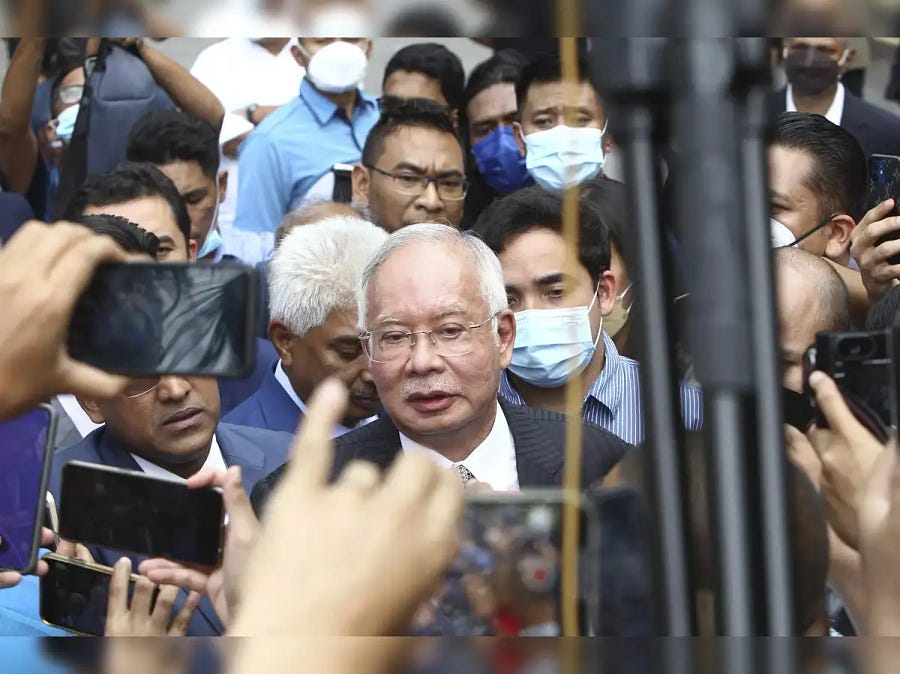
On the morning of December 26, 2025, the Palace of Justice in Putrajaya felt less like the site of a reckoning than the end point of an administrative process that had taken far longer than anyone originally expected. The building’s wide corridors echoed faintly with footsteps as lawyers arrived carrying folders that had grown thicker with every passing year. Court staff moved deliberately, as if aware that nothing about this case could be hurried, not even its conclusion.
Najib Razak was already seated when proceedings began. At seventy-two, Malaysia’s former prime minister appeared composed and his expression controlled. He opened a notebook as the judge entered and would return to it repeatedly over the next several hours, writing in short bursts, pausing, then continuing, as though recording a personal ledger of a public collapse.
Justice Collin Lawrence Sequerah began reading the decision shortly after the court was called to order. The ruling unfolded slowly, not for dramatic effect but because the path of the money demanded patience. The judge traced transactions across borders and years, reconstructing how hundreds of millions of dollars entered Najib’s personal accounts through channels that bore none of the hallmarks of legitimate political donations. When the defense again invoked Saudi benefactors, the court dismissed the claim as a fabrication, describing the supporting letters as forgeries and the explanation as implausible in light of documentary evidence.
By the time the sentence was delivered, fifteen years in prison alongside fines and asset seizures amounting to roughly $3.3 billion, the courtroom had settled into silence. Najib showed little visible reaction. This sentence would not begin immediately. He has been imprisoned since August 2022 on earlier convictions related to the same scandal, and the new term will commence only after his current sentence ends in 2028. The law moved as it always does, incrementally, indifferent to symbolism.
To understand how Malaysia arrived at this moment, it is necessary to return to 2009, when Najib entered office with unusual authority. He was both prime minister and finance minister, an unusual concentration of power that gave him sweeping influence over fiscal decisions. Shortly after taking office, he established 1Malaysia Development Berhad, or 1MDB, a sovereign wealth fund presented as a vehicle for national development. Najib chaired its advisory board. The fund answered to him.
The early ambitions of 1MDB were expansive. Officials spoke of foreign partnerships and infrastructure projects that would propel Malaysia forward, eyeing the likes its neighbor, Singapore. In September 2009, the fund announced a joint venture with PetroSaudi International, pledging $1 billion in capital. Within months, investigators would later conclude, much of that money had been diverted into accounts controlled by intermediaries linked to a young financier named Low Taek Jho, known widely as Jho Low.
Low was not a government official. Educated at Harrow and the Wharton School, he cultivated proximity to power rather than formal authority. Emails and bank records later presented in court showed how funds moved from 1MDB into offshore entities, then onward into private accounts. Swiss banks, Singaporean institutions, and correspondent banks in the United States processed transfers that, in retrospect, raised questions few chose to ask at the time.
The scale of the operation expanded dramatically between 2012 and 2013, when Goldman Sachs underwrote three bond offerings for 1MDB worth a combined $6.5 billion. The fees earned by the bank, nearly $600 million, were unusually high. Prosecutors later argued that billions from these bond proceeds were siphoned into shell companies controlled by Low and his associates. The machinery of global finance did what it was designed to do, which was to move money efficiently, with little care for internal oversight and external scrutiny.
By 2013, hundreds of millions of dollars had entered Najib’s personal bank accounts. He would later say that he believed the funds were donations from the Saudi royal family, a claim that unraveled under examination. Bank records showed circular movements of money. Some funds were returned to offshore accounts after public scrutiny intensified, a gesture the court interpreted as concealment rather than correction.
The scandal might have remained contained within financial circles if not for investigative reporting. In 2015, Clare Rewcastle Brown, a British journalist born in Sarawak, published documents suggesting that nearly $700 million linked to 1MDB had flowed into accounts associated with Najib. Her reporting drew from leaked emails provided by Xavier Justo, a former PetroSaudi executive. The revelations triggered investigations across multiple jurisdictions, including the United States, Switzerland, Singapore, and Luxembourg.
In Washington, the US Justice Department described 1MDB as the largest case ever pursued under its Kleptocracy Asset Recovery Initiative. Prosecutors alleged that more than $4.5 billion had been misappropriated between 2009 and 2014. Some of the money financed luxury real estate in New York and Los Angeles. Some purchased art by Monet and Van Gogh. Some underwrote the production of Leonardo DiCaprio’s The Wolf of Wall Street, a film about excess that would later become a cultural shorthand for the scandal itself.
In Malaysia, public anger mounted. In August 2015, tens of thousands gathered in Kuala Lumpur under the banner of the Bersih movement, demanding accountability. Najib responded by removing officials investigating the fund, including the attorney general. Sarawak Report was blocked domestically. The government insisted that the allegations were politically motivated.
The reckoning arrived at the ballot box in May 2018. Najib’s coalition, which had governed Malaysia since independence in 1957, was defeated. The opposition, led by Mahathir Mohamad, returned to power on a platform centered on corruption. Najib was arrested later that year. Charges followed. Trials accumulated.
In 2020, Najib was convicted in the SRC International case, involving 42 million ringgit siphoned from a former 1MDB unit. He was sentenced to twelve years in prison. Appeals failed. In August 2022, he reported to Kajang Prison, becoming the first former Malaysian prime minister to be incarcerated. A pardons board later halved his sentence and reduced his fine, a decision that drew criticism but did not erase the underlying convictions.
Meanwhile, the international fallout continued. Goldman Sachs reached a $2.9 billion settlement with the Malaysian government in 2020. Roger Ng, a former Goldman banker, was convicted in the United States and sentenced to ten years in prison. Tim Leissner, another former executive, pleaded guilty and cooperated with prosecutors, receiving a reduced sentence. JPMorgan agreed in 2025 to pay $330 million to settle claims related to its role in facilitating transactions tied to 1MDB.
Jho Low, identified by courts as a central orchestrator of the scheme, remains at large. His whereabouts are believed to be in China, though this has never been confirmed publicly. He has denied wrongdoing. His absence has become a defining feature of the scandal, a reminder that global financial crime often ends unevenly.
On December 26, as Justice Sequerah concluded his ruling, Najib stood briefly, then sat again. The judge noted that the former prime minister was no naïf, that he possessed intelligence, experience, and authority, and that attempts to portray him as unaware of the funds flowing into his accounts were inconsistent with the evidence. The law, the judge said, could not accommodate such a narrative.
Outside the courthouse, supporters held signs bearing Najib’s image. Some spoke of loyalty. Others spoke of political persecution. Across Malaysia, reactions were divided, though quieter than in earlier years. The case had lasted too long to shock anyone. It had become part of the country’s political weather.
By 2024, the United States had helped return more than $1.4 billion in assets to Malaysia, including properties and artworks. The money recovered represents a fraction of what was taken, though even partial restitution has reshaped how sovereign wealth funds are scrutinized. Compliance departments now cite 1MDB in training materials. Regulators invoke it when arguing for tighter oversight.
Najib Razak will remain a presence in Malaysian politics, even from prison. His party retains influence within the governing coalition. His supporters continue to argue that history will judge him more kindly. The courts, for their part, have spoken in the language they know best, methodical and unsentimental.

