
Development Without Enemies
 Tosin Adeoti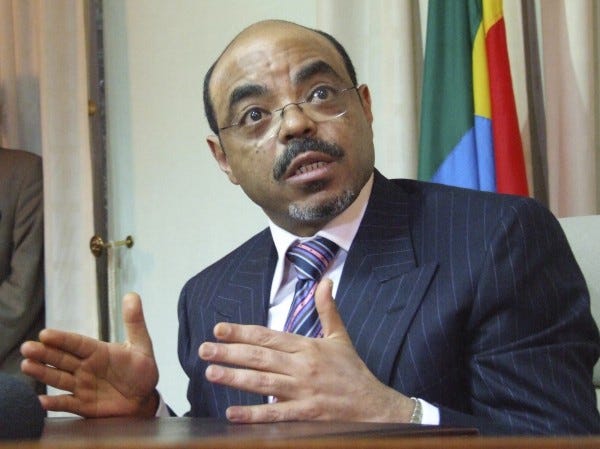
I have been thinking a lot lately about Iran. The country demonstrates how much development can be lost when relations with major powers collapse. Iran ranks around 17th in the world for scientific publications based on SCImago and Scopus data. The Persians produced more than 78,000 scientific papers in 2022 alone. That is impressive because Iran’s population and economy are far smaller than many countries above it. And it makes me wonder what might have been if its leaders were a little more shrewd.
And as usual, I couldn’t help linking this to many African countries.
Meles Zenawi had ruled Ethiopia from 1991 until his death in August 2012. When he assumed power after the fall of the Marxist Derg regime, Ethiopia was one of the poorest countries in the world. Images of famine in the 1980s had burned themselves into global memory. Millions of people survived on emergency food aid. Roads barely connected distant regions. Industry existed only in fragments. Many foreign analysts predicted that Ethiopia would remain dependent on aid for generations.
Zenawi rejected that fatalism. He believed Ethiopia could grow quickly if the state guided development with discipline. Between 2004 and 2011 Ethiopia’s economy expanded at an average rate above ten percent per year according to the World Bank. Millions of people moved out of extreme poverty during that period. The transformation did not occur without controversy or criticism, yet it was impossible to ignore the momentum that had taken hold.
What made Zenawi unusual among many leaders in the developing world was not only his focus on economic policy. It was his understanding of geopolitics. Ethiopia pursued growth with remarkable ambition, yet the government remained careful not to trigger direct confrontation with global powers whose reactions could derail the project. Joe Studwell in “How Africa Works” explains how Zenawi spoke often about development economics in academic language, quoting scholars and debating policy frameworks, although he also displayed a cautious instinct about the international balance of power.
When the United States launched its global campaign against terrorism after the attacks of September 11, 2001, Ethiopia positioned itself as a strategic partner in the Horn of Africa. Ethiopian troops cooperated with Western security efforts in Somalia against militant groups. The relationship gave Ethiopia diplomatic leverage and a degree of protection. Western governments criticized aspects of Ethiopia’s domestic politics, yet the country remained an important partner in a volatile region. Aid continued to flow. Investment increased. Ethiopia pursued infrastructure projects that transformed its landscape.
That careful balance illustrates an uncomfortable truth about development in the modern world. Economic leadership is not only about designing effective policies or building infrastructure. It also requires a subtle understanding of global power. A country that grows too quickly or behaves too independently can find itself under intense pressure from larger states that fear losing influence. Development can attract resistance if it appears to threaten established hierarchies.
History provides many reminders of this reality. Consider the story of Patrice Lumumba in 1960. In his book, “The Lumumba Plot” by Stuart A. Reid, Lumumba stood before the Belgian king during Congo’s independence ceremony in June of that year and delivered a speech that stunned the room. He spoke openly about colonial exploitation and declared that Congo would control its own destiny. Detailing the atrocities of the Belgians, he talked of how they “brought us deep suffering”. The speech electrified many Africans who had lived under colonial rule, yet it also alarmed powerful governments that viewed the Cold War through the lens of strategic minerals and geopolitical alliances.
Congo possessed enormous deposits of copper, uranium, cobalt, and diamonds. Western governments feared the possibility that the country might align with the Soviet Union or attempt to nationalize key industries. Within months, Congo descended into political chaos. Regional secessions erupted. Foreign interests maneuvered behind the scenes. Lumumba was overthrown and later killed in January 1961. Historians continue to debate the full details of the episode, yet there is broad agreement that international rivalries played a role in shaping Congo’s fate.
The tragedy of Lumumba did not occur in isolation. The Cold War left a long trail of leaders in the developing world who attempted ambitious national projects while navigating a hostile geopolitical environment. Some succeeded for a time. Others paid a heavy price for misreading the intentions of stronger powers.
In Asia, the story unfolded differently. During the late twentieth century, Lee Kuan Yew approached development with an almost obsessive awareness of geopolitics. Singapore in 1965 was a small island with limited natural resources. Its population faced uncertain prospects after separation from Malaysia. Lee and his colleagues focused on economic transformation with remarkable discipline. They invested in education, port infrastructure, and industrial policy. At the same time, Singapore cultivated close relationships with both Western powers and neighboring countries. Lee rarely allowed ideological posturing to interfere with pragmatic diplomacy. He understood that a small nation surrounded by larger forces had little room for reckless confrontation.
The results are visible today. Singapore’s GDP per capita exceeds that of many advanced economies. The port of Singapore remains among the busiest in the world. Investors regard the city-state as a hub of stability in a turbulent region. Lee Kuan Yew often reminded audiences that development required clear-eyed realism about power. Nations that ignore geopolitical constraints risk sabotage or isolation.
African leaders operate in a similarly complex environment. The continent contains immense resources, a young population, and expanding markets. At the same time, global competition for influence has intensified. China finances railways and ports across Africa through initiatives associated with Belt and Road Initiative. The United States seeks strategic partnerships and security cooperation. European countries pursue trade agreements and migration policies. Russia expands diplomatic and military engagement in several regions. Each of these powers carries its own interests, priorities, and anxieties.
A leader who intends to transform an African economy must therefore think beyond domestic policy. Infrastructure projects, industrial strategies, and education reforms are essential. Yet the success of these efforts can depend heavily on how external powers perceive the country’s trajectory. A government that antagonizes several major actors simultaneously may find itself confronting sanctions, financial pressure, or diplomatic isolation. Development plans can collapse under that weight.
This does not mean African leaders should abandon ambition or surrender sovereignty. The lesson is more subtle. Successful development requires a balance between bold economic transformation and careful geopolitical positioning. The ability to build roads, power plants, and industries must coexist with the skill to reassure powerful nations that growth will not threaten their core interests.
Examples of this balancing act already exist across the continent. Rwanda under Paul Kagame has pursued rapid economic modernization while maintaining strong relationships with Western donors and regional partners. Morocco has expanded manufacturing exports and renewable energy while cultivating diplomatic ties with Europe, the United States, and Gulf states. Botswana has sustained decades of stable growth through cautious governance and partnerships with international mining companies. Each case involves different political choices, yet the underlying principle remains consistent. Development unfolds within a global arena shaped by power and perception.
The challenge for Africa in the twenty-first century is to produce leaders who understand both dimensions of this reality. Economic competence alone will not guarantee success. Visionary development plans can falter if they collide with geopolitical tensions. Conversely, diplomatic skill without a commitment to economic transformation leaves countries trapped in stagnation.

