
The Bullet That Unravelled a Church
The Bullet That Unravelled a Church
 Tosin Adeoti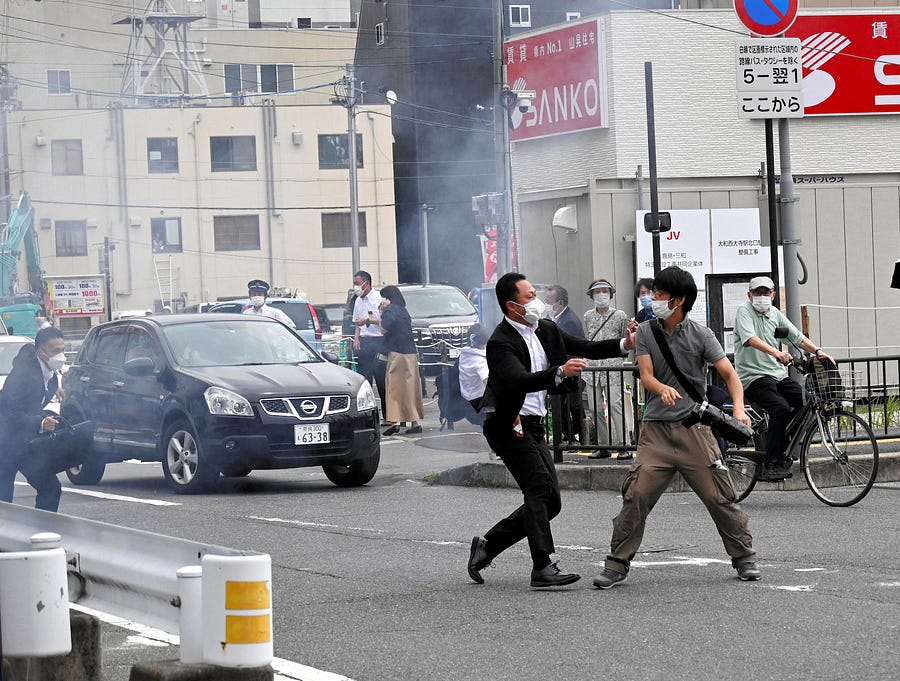
On the morning of 8 July 2022, the air in Nara, an ancient city known for its temples, carried the quiet rhythm of a summer campaign day. A small crowd gathered outside Yamato-Saidaiji Station, standing politely in the restrained manner that characterises public life in Japan. At the centre of the gathering stood Shinzo Abe, one of the most recognisable political figures the country had produced in a generation. Abe was delivering a short campaign speech in support of a candidate from the Liberal Democratic Party ahead of national upper-house elections.
His voice rose and fell through a microphone attached to a campaign van, drifting over the hum of passing cars and the metallic clang of trains arriving at the nearby station. Security officers stood nearby, but the atmosphere was relaxed. Japan has some of the strictest gun laws in the world, and political violence has long been considered almost unimaginable in modern Japanese society. People listened calmly, some holding umbrellas against the sun, others filming the speech on their phones.
Then a sudden sharp sound cracked through the air.
At first many people thought it was a firecracker or a piece of equipment malfunctioning. Abe himself paused briefly, turning his head with a puzzled expression before continuing his speech. Seconds later a second explosion rang out, louder and unmistakably violent. Panic swept through the crowd as Abe collapsed onto the pavement, his security team rushing forward while bystanders screamed and scattered. A cloud of grey smoke drifted across the street, and in the confusion police officers tackled the man responsible, who stood holding a crude homemade firearm.
Within hours the news reverberated across the world. Shinzo Abe, Japan’s longest-serving prime minister and one of the most influential figures in the country’s post-war political history, had been fatally shot in broad daylight. In a nation where gun violence is extraordinarily rare, the assassination stunned the public and left the political establishment scrambling for answers. Investigators quickly focused on the obvious question that hung over the tragedy: why had anyone targeted Abe in the first place?
The answer would lead authorities into the complicated history of a controversial religious movement that had operated in Japan for decades. That movement, formally known as the Family Federation for World Peace and Unification, was more widely recognised by its older name, the Unification Church.
The Man With the Homemade Gun
The suspect arrested at the scene was Tetsuya Yamagami, a 41-year-old former member of Japan’s Self-Defense Forces. As investigators began questioning him, his explanation for the attack revealed a motive that had little to do with conventional political grievances. Yamagami said that he believed Abe maintained ties to the Unification Church and that his own family had been financially ruined because of the organisation.
According to his statements, the resentment had been building for years. His mother had become deeply involved with the church and gradually donated enormous sums of money to the organisation. As the contributions mounted, the family’s savings disappeared. Bankruptcy followed, and the household slipped into long-term financial hardship. What began as religious devotion, Yamagami believed, had ultimately destroyed his family’s stability.
The bitterness grew quietly over decades. Yamagami later explained that the church’s aggressive fundraising practices had left deep scars on his life and the lives of his siblings. Convinced that the organisation had exploited his mother’s faith, he began researching individuals he believed were connected to the movement’s influence in Japanese politics. In his mind, Shinzo Abe became a symbolic figure representing that connection.
Investigators later revealed that Abe had not been Yamagami’s original target. The attacker had initially hoped to confront Hak Ja Han, the widow of the church’s founder and its current leader. When he realised that reaching her would be impossible, he redirected his anger toward Abe, whom he believed had publicly supported events organised by groups linked to the church.
The assassination therefore had consequences far beyond the death of a single political leader. It forced Japanese society to confront a religious organisation whose activities had long generated controversy but had rarely been examined with such intense scrutiny.
A Church With Global Ambitions
The story of the Unification Church began far from Japan’s political landscape. In 1954, a Korean religious leader named Sun Myung Moon established a new spiritual movement in Seoul. The organisation was originally called the Holy Spirit Association for the Unification of World Christianity, reflecting Moon’s ambition to create a global religious community that would transcend denominational boundaries.
Moon claimed that his mission had been revealed through a mystical experience in 1935, when he said Jesus Christ appeared to him and entrusted him with completing a divine task that Christianity had left unfinished. His teachings were later compiled into a theological text known as the Divine Principle, which blended elements of Christian doctrine with Moon’s own interpretation of human history and spiritual destiny. Within the movement, Moon and his wife, Hak Ja Han, came to be regarded as the “True Parents” of humanity, figures destined to restore moral harmony to the world.
The church grew rapidly during the Cold War era, particularly because of its strong anti-communist stance. It expanded beyond Korea into the United States, Japan, and parts of Europe and Latin America. One of its most famous rituals involved large-scale mass wedding ceremonies in which thousands of couples were married simultaneously. Many of the participants had never met before the event, having been matched by the organisation through an elaborate pairing process designed to unite believers across national and cultural lines.
Japan became one of the movement’s most important bases outside Korea. The organisation gained official recognition as a religious corporation in 1964, allowing it to operate with legal protection and tax advantages. Over time it built a sprawling network of affiliated institutions that included media outlets, educational organisations, and political advocacy groups. Critics, however, argued that behind this impressive institutional structure lay troubling patterns of manipulation and financial pressure placed on believers.
The Hidden Cost of Faith
For many Japanese families, involvement with the church came with severe financial consequences. Former members frequently described relentless pressure to donate money, often framed as spiritual obligations tied to salvation or redemption for ancestral sins. In some cases believers were encouraged to purchase expensive religious items or make donations far beyond their financial means.
These practices eventually attracted the attention of Japanese courts. Over the years, a growing number of lawsuits were filed by individuals who claimed they had been coerced into making enormous contributions to the organisation. Some plaintiffs described being told that failure to donate would bring misfortune upon their families, a tactic critics characterised as psychological manipulation.
By the time authorities began examining the church closely after Abe’s assassination, the scale of the damage had become clear. Government investigations estimated that more than 1,500 people had suffered financial harm linked to the organisation’s fundraising practices. The combined losses were believed to approach ¥20.4 billion, roughly 140 million dollars, a staggering figure that illustrated how deeply the movement’s influence had penetrated Japanese society.
Behind those statistics were deeply personal tragedies. One widely reported story involved Tatsuo Hashida, whose family had been torn apart after his former wife became heavily involved with the church. As donations consumed their finances, the household collapsed under the strain. Their eldest son eventually died by suicide, a loss that Hashida has said he believes was connected to the devastating pressures created by the family’s financial ruin.
For families like his, the legal battle against the church was never simply about money. It was about recognition and accountability for years of suffering that had often been ignored by authorities.
From Public Outrage to Legal Action
The assassination of Shinzo Abe created a wave of public anger that rapidly transformed into political pressure. Journalists began investigating the historical connections between Japanese politicians and the Unification Church, uncovering numerous instances in which lawmakers had attended events organised by church-affiliated groups or received support from associated organisations.
As public scrutiny intensified, several members of the Liberal Democratic Party acknowledged past interactions with the church, although many insisted that those contacts had been limited or purely ceremonial. Nevertheless, the revelations created a climate in which the government could no longer ignore the controversy surrounding the movement.
In October 2023, Japan’s Ministry of Education, Culture, Sports, Science and Technology took a dramatic step by petitioning the Tokyo District Court to revoke the Unification Church’s status as a legally recognised religious corporation. The request was extraordinary because such measures had been used only twice before in modern Japanese history.
One previous case involved Aum Shinrikyo, the doomsday cult responsible for the Tokyo subway sarin attack. The other concerned a Buddhist temple whose leader had been convicted of fraud. In both instances criminal behaviour played a central role in the decision.
The government’s case against the Unification Church was unusual because it relied largely on civil violations and patterns of harmful behaviour rather than criminal convictions. Even so, judges concluded that the organisation’s activities had caused significant damage to public welfare. In March 2025, the Tokyo District Court ruled that the church should lose its legal status, a decision that the organisation immediately appealed.
The Final Decision
The case reached its decisive moment in March 2026, when the Tokyo High Court upheld the lower court’s ruling. The decision ordered the dissolution of the Unification Church as a recognised religious corporation in Japan, stripping the organisation of the tax privileges and legal protections it had enjoyed for decades.
Under the ruling, a court-appointed administrator would assume control of the church’s assets and begin a process designed to compensate victims who had suffered financial harm. The judgement marked only the third time in Japanese history that a religious organisation had been stripped of its legal status under the country’s Religious Corporations Act.
For many observers, the case represented a significant turning point in Japan’s relationship with controversial religious movements. For decades authorities had been reluctant to intervene in religious affairs, concerned about protecting constitutional guarantees of freedom of belief. The assassination of Shinzo Abe, however, changed the political and moral calculus.
The court’s ruling did not ban the Unification Church outright, and the organisation can still operate as a voluntary association. Yet the loss of official status dramatically alters its financial structure and public legitimacy within Japan.
For decades the Unification Church had operated on the margins of Japanese public debate, criticised by former members and activists but rarely confronted directly by the state. And on Tuesday, the Japanese judiciary eventually decided that enough is enough.

