
Book Review — “King of Kings” by Scott Anderson
Book Review — “King of Kings” by Scott Anderson
 Tosin Adeoti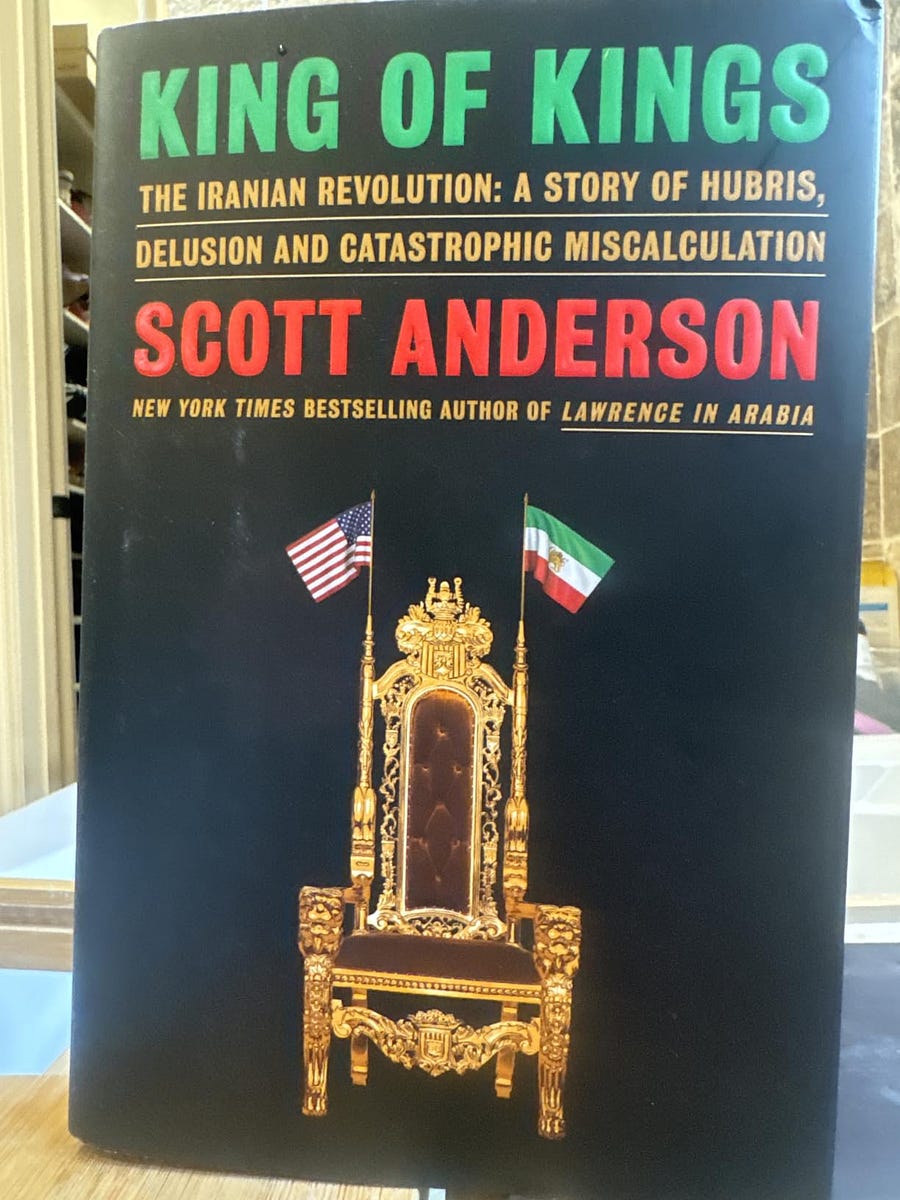
“I think I was always looking for a kind of personal test, both of myself and of my faith,” George Braswell said in explaining the unusual turn his life took in 1968. “Iran gave me that.”
That opening line captures the power of King of Kings. Scott Anderson’s book is deeply enjoyable, not because the events are pleasant, but because they are told with narrative urgency. This is history written with the pacing of a thriller and the gravity of tragedy.
At the center stands Mohammad Reza Shah Pahlavi, a man surrounded by titles and ritual. Anderson describes the choreography of power with unsettling precision. Courtiers bowed deeply, kissed the shah’s hand, and whispered prayers for the “King of Kings, Light of the Aryans, Shadow of God on Earth.” Yes, those were his titles. ‘King of Kings’. For such a man no one comes to his presence and is allowed for the Shah to see his back literally. No one spoke plainly. His court became an echo chamber where reality was filtered into reassurance.
What makes the story more astonishing is how unthinkable collapse seemed. On the eve of the shah’s 1977 visit to Washington, a classified CIA analysis concluded that his grip on Iran was unassailable. He enjoyed American backing, cordial ties with the Soviets, discreet cooperation with Israel, and command of the fifth-largest military in the world. If outside forces determined outcomes, the monarchy looked immortal. Anderson rightly calls this conclusion risible in hindsight, but he shows why it felt persuasive at the time.
The book shines in its minute-by-minute reconstruction of failure. Ambassadors sent sanguine cables while cities burned while advisers reassured when they should have warned. The shah himself vacillated, paralyzed by illness, superstition, and moral confusion. When the military finally refused to fire on protesters again, the spell broke.
Religion runs through the book as force. Anderson details the medieval rhetoric Khomeini used to mobilize crowds, urging them to “arise and sacrifice your blood.” He also traces Iran’s deep current of superstition, including rumors that Khomeini’s face appeared on the moon. These beliefs mattered for they moved people faster than policy ever could.
Khomeini, along with his three key lieutenants, emerges as a master tactician rather than a mystic. From exile in France, he played expertly on Western fears of a Soviet takeover, winning American hesitation at a critical moment while the support to the Shah would have been pivotal —the book’s description of Jimmy Carter as a hapless and impotent leader laid the ground for the fiasco that would soon follow. Khomeini’s return to Iran was staged with chilling symbolism, ending at a cemetery, his preferred burial ground, to bind revolution and death together.
Anderson refuses moral simplification. The shah was not a good man, but the revolution that replaced him was worse by almost every measurable standard. The book dismantles inflated casualty figures repeated by Western media before 1979, then contrasts them with the documented executions under Islamic rule. By the best estimates, fewer than 1000 dissidents were killed by the shah’s secret police in his final decade. In the first four years after the revolution, more than 8000 were executed. When power shifted, violence multiplied in folds.
The long-term consequences radiate far beyond Iran. Anderson reflects that much of today’s global violence is animated by religious militancy, whether Buddhist, Christian, Jewish, Hindu, or Islamic. While the Iranian Revolution did not invent this phenomenon, it globalized its modern expression. That legacy still burns.
The oil politics alone read like a case study in strategic myopia. OPEC brinkmanship, Saudi restraint, American manipulation, and the shah’s hunger for price hikes all combined to strain Iran’s economy and legitimacy. When an earthquake struck and the government rejected foreign aid, the regime’s incompetence became undeniable. Even nature seemed to turn against it.
One of the book’s quiet lessons is institutional. The absence of an independent deputy and trusted second voice proved fatal. When the shah’s closest confidant died, no one replaced him. Disaster exposed the cost of absolute loyalty.
King of Kings is not an apology for monarchy, nor a defense of empire. It is a warning. Anderson shows how states collapse when leaders believe their own myths, when outsiders mistake stability for permanence, and when moral outrage blinds observers to comparative reality.
Reading about the abuse of American hostages after 1979, it is hard not to note the hypocrisy of regimes, especially those in developing countries, that loudly condemn Western sins. When power tilts in their favor, we see how their actions rival those of those they condemn.
This book makes unsettling clarity possible. It explains why modern Gulf monarchies react so harshly to dissent, not because repression is admirable, but because memory is long and fear is rational. They have seen what miscalculation can unleash.
King of Kings is history with teeth. It is tragic, incisive, and written with rare narrative confidence. You finish it with fewer illusions and a sharper understanding of how the modern world was broken open.

