
The Man Who Carried Two Lives at Once
 Tosin Adeoti
 From Snowboarder to Fugitive: The Ryan Wedding Story
It was mid-morning in Thunder Bay when Ryan Wedding first slid onto a snowy slope. The light was soft, not yet sharp, and the hill was still waking up. He wore a wool cap that belonged to his grandfather, its threadbare edges flapping in the cold breeze. At twelve, he could feel something in the air that others did not. Snow was not just cold; it was a place where motion became meaning, where speed and silence met beneath your feet.
Ryan’s grandparents owned that ski hill. They ran it like a careful secret, a place people came to find quiet in the long winters. In those days, Ryan’s father, a mechanical engineer with experience that carried him across countries, taught him how to watch a machine’s pulse. His mother, a registered nurse grounded in care and kindness, taught him how to notice when something was wrong. Ryan listened well. He learned both lessons deeply.
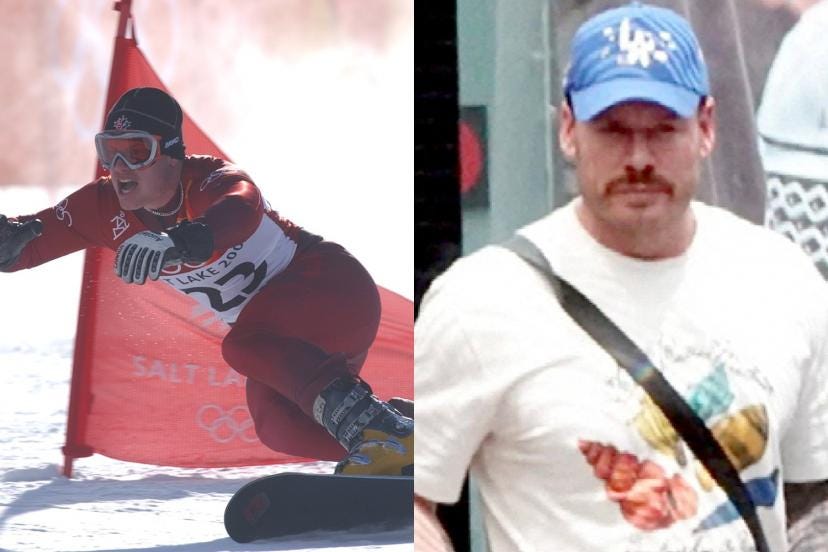
Two decades later, on a wide slope above Salt Lake City, he stood in a red uniform with the Olympic rings stitched near his shoulder. The snow reflected the sun, almost too bright to look at, and the air had a thin taste of expectation. Cameras blinked. He breathed in deeply, feeling the moment gather itself around him. He pushed off, carving down the slope with precision and power. There was no question in the way he leaned into each turn. He seemed to be speaking a language the snow already knew.
The applause and recognition that followed could have been enough for many people. But for Ryan Wedding, it became a memory that sat beside something stronger, something less forgiving.
Years passed. The roads were longer, the crowds quieter, and the hills less welcoming. In June 2006, Canadian police officers executed a raid on a marijuana farm in British Columbia. It was far from the grand stages of Olympic competition. Ryan’s involvement in that farm marked his name in local headlines and law enforcement files. It was the beginning of a shift in his life that most people did not see coming.
By 2008, Ryan found himself in federal court in San Diego. He had been arrested in a sting operation, attempting to buy large quantities of cocaine. Thirty kilograms. The scene was far from snow and international stadiums. The room was stark and grey, the lighting unforgiving. When agents approached him, he did not flinch. He met their eyes with an expression that seemed to say he did not think he was there to be caught. In interviews afterward, the lead agent, Brett Kalina, recalled Ryan’s reaction. “He was different,” Kalina said. “He did not show fear. He was arrogant, like he felt himself above the moment.”
In the months that followed, Ryan was held at the Metropolitan Correctional Center in San Diego. The walls were thick and unresponsive. He spent hours on a phone line monitored by agents, talking to figures he would later rely on. Names that would appear in court documents years later were whispered in those late-night conversations. Friends who exchanged information and planned movements that would allow a new version of his life to rise from the ashes of the old.
Ryan served roughly three and a half years in prison before being transferred to a federal facility in Texas. When he walked out in late 2011, his clear intention was to build something new, and this time on his own terms.
By 2013, he had established a drug-trafficking organisation. In court records filed decades later, U.S. and Canadian prosecutors described how the network spanned borders. It had roots in Montreal and connections reaching into Mexico. The business was a network of payments and loyalty built on fear and mutual benefit.
At first, people spoke about his operation quietly. Observers in law enforcement noticed that cannabis crops continued to flourish in Ontario forests and Quebec fields. The trend pointed back to networks that had learned how to move outside the view of customs and patrols. Eventually, attention sharpened. The FBI and the Royal Canadian Mounted Police began sharing intelligence. An operation was organised, labelled by agents as “Operation Giant Slalom,” a dark nod to Ryan’s skiing roots.
The turning point came in January of 2025. In Medellín, Colombia, a man who had agreed to act as a government informant ate lunch with friends at a small restaurant off a side street. The sunlight cut across the tables, and the chatter was loose and unguarded. Without warning, a figure in a dark hoodie approached from behind. A gun fired, and the informant fell. Moments after the killing, a photograph of the body was sent to Ryan Wedding. The image circulated among his contacts, and the man was called “the rat.”
The killing electrified law enforcement agencies. Ryan had placed a bounty on the informant’s head, estimated in millions of dollars. The act was not merely violence; it was a message, and a catastrophic one. Within days the FBI added him to its list of Ten Most Wanted Fugitives.
In response, Washington raised its reward for information that could lead to his arrest and conviction. The offer climbed to $15 million, a number that reflected not only the severity of his alleged crimes but also the level at which his network was now understood to operate.
The FBI released an image it claimed was of Ryan in Mexico. In it, he lay in a bed, his torso bare, a tattoo of a lion sprawled across his chest. The photograph seemed incongruous with the smooth, aerodynamic form of the snowboarder who once glided down Olympic slopes in 2002. The years had etched a hardness into his expression. The photo was an arresting reminder of the transformation his life had taken.
In Montreal, retired RCMP intelligence expert François Mathieu described the significance of the case. He spoke of Canada’s place in the broader trade, noting that the notion of a northern, sleepy country untouched by serious trafficking had long been a misconception. Evidence of Ryan’s network, Mathieu explained, showed connections deep into cities that once seemed insulated from such violence.
During the multi-year investigation that followed the Medellín killing, law enforcement agencies in several countries arrested associates of Ryan Wedding. High-ranking officials described the pursuit as relentless. A right-hand man, identified in court records as Andrew Clark and known by others as “The Dictator,” was eventually apprehended and extradited to the United States. Court documents suggest he became a cooperating witness for the authorities in continued efforts to dismantle the network.
The complexity of the case revealed itself in unexpected places, including legal briefs where lawyers debated strategy, in extradition hearings, and in the careful catalogue of evidence drafted by prosecutors that traced communications and financial transfers. There were stories of houses purchased for operatives, promises of cosmetic surgeries to secure loyalty, and payments that followed routes as unpredictable as they were extensive.
Agents who had spent years on the case watched the web expand and contract like the tide. By early December of 2025, Mexican authorities had conducted multiple raids. They seized personal items traced to Ryan Wedding, including two Olympic medals and an array of motorcycles that in another life might have belonged to a touring enthusiast. To investigators, these objects were relics of an identity that had fractured over time.
On a humid evening, when the sun had leeched its heat from the day and shadows gathered in the corners of a small coastal city in Mexico, local law enforcement agents moved in.
Ryan Wedding, 44, was taken into custody.
He did not struggle.
There were no dramatic scenes of pursuit or helicopters overhead. The moment was quieter than many rumours that had swirled around him. When the cuffs were placed on his wrists, there was a long pause between what he saw and how he reacted. The years of running, the careful construction of a new life built on fear and loyalty, converged in a single span of breath.
He was bound for the United States.
As officers led him into a waiting vehicle, news crews gathered at a distance, their cameras trained like unblinking eyes. For people who had watched the story from afar, the image of the captured fugitive in handcuffs was jarring. Some remembered the young athlete on snow, smiling and unguarded. Others saw a man whose choices had led to a global manhunt, violence, loss, and law enforcement mobilised across continents.
Standing nearby, an FBI agent spoke quietly to a reporter about the significance of the arrest. He noted the meticulous work that had brought them to that moment — the years of coordination among agencies, and the importance of accountability even when the path to reach it had been violent and tangled.
In the end, Ryan Wedding’s capture was not an abrupt end. In many ways it was the conclusion of a long descent, a story that began with motion on snow and ended in restraint on a sweltering Mexican street. He would now face the consequences of actions that had taken him far from the hills of Thunder Bay and placed him at the centre of an international investigation that drew in cities, courts, and agencies across borders.
By the time the sun dipped below the horizon and the cameras packed up their gear, one thing was certain: the life Ryan had once imagined for himself, full of motion and possibility, had dissolved into a landscape defined by pursuit and consequence.

